Showing posts with label Dom's Decals. Show all posts

8.03.2026

Genda's Blade


Website image - not great
I am trying to fill in gaps in my World War II gaming -the challenge being the number of theaters that makes this an impossible task to go along with my interest in just about everything. Regardless of my lack of focus, recently I have been looking at late war action in the Pacific, and to that end purchased the "Genda's Blade" pack from I-94. The pack features either eight or sixteen Kawanishi N1K2-J Shiden-Kai (Violet Lightning-Improved) fighters (Raiden Miniatures) along with a decal sheet for the 407th Hikotai (made by the now defunct Dom's Decals) which is not available for separate purchase (and because I have a bit of an addiction, I have also ordered the same planes from Flight Deck Decals, for a future comparison post). The N1K2-J, known to the Allies as "George", was a beast - fairly fast, decently maneuverable, and armed with four 20mm cannons, albeit I believe the same type found on the A6M series (and hence meriting only LVC in Check Your 6!). 

My image, a little better
The term Genda's Blade comes from the formation of the 343rd Kōkūtai, an elite unit created in late 1944 by Minoru Genda, himself an extremely experienced pilot, although one with no victories during the war. Genda recruited the best Japanese Navy pilots he could gather, which included several aces. The following chart lists some of them and their number of kills before joining the 343rd (if Japanese records can be believed). Bear in mind I use the same convention for rating aircrews as found in the Battles Above series of scenario books with experts having fifty kills or more given a +4 rating and the ability to adjust up to three turn codes left or right of the originally plotted turn code (although I still need to test that last tweak a bit). Aces then have twenty to forty-nine kills, veteran aircrews are either highly experienced and/or have five to nineteen kills, skilled pilots are well trained and/or have one to four kills, and green are just that. 


Several other pilots became aces while serving with the 343rd Kōkūtai. Overall, aircrew quality for the kōkūtai should be similar to early war Japanese ratings, with little to no green aircrews, a bulk of skilled, and as you see from the above table, numerous veterans.

Raiden version - needs some cleanup but the casting is crisp

When American pilots encountered this unit, they realized they were not facing the remaining dregs of the Imperial Japanese Navy Air Force, but pilots with skill as great if not better than their own, flying an aircraft as good if not better than their own. 

There is an exceptional book titled...wait for it...Genda's Blade! This detailed offering provides an insight, through several first person accounts. However, the book is out of print and is expensive on the aftermarket sites. But if one wants a deep dive into The N1K and/or the 343rd Kōkūtai, it is a must have title. Using Genda's Blade and AI I will be woking up some scenarios in the future.

1.11.2026

The First Victory AAR

My pair of Yaks in lower left corner.
I hosted (and played) The First Victory scenario from the Check Your 6! Korean War scenario book this past weekend for the group. Alas, it was another one of those times in which I did not remember to take many pictures, but I can cobble together a bit of an after action report this go-around.

We had three North Korean players with a pair of Yak-9s each, facing off against three players flying a pair of F-80s (high cover) and three Twin Mustangs. The Yaks had a mission to get their aircraft of the edge of the board, although the scenario seems to be a bit confused on which edge and even with how the setup was described (Board Edges 1 and 2 do NOT intersect so one cannot set up their planes within ten hexes of that intersection), but we managed. The Yaks and Mustangs were pretty much on the deck, and with visibility only sixteen hexes it took a few turns for spotting range to be achieved. I made the players fly level and use only forward turn codes until a spotting check was passed. Then the fun began.

Denying Mustangs their due while the F-80s are in a futile chase.


We had four Korean Yaks line abreast (with a hex in between each) with my pair lying support a few hexes behind. One pair went for the deck with the goal of getting off the victory point edge while the other two players mixed it up with the Shooting Stars (once they came down to play) and Twin Mustangs. With mostly green crews on the board, shots were not easy to come by, but one F-82 shot down a Yak, evening the numbers. However, while the F-80s turned to chase the pair of Yaks screaming for the board edge, a series of maneuvers meant that the remaining Yaks were now engaged and unable to really break away. I placed my pair of Yaks with a couple of pretty good tail shots, but of course missed both. At that I had a chance to break for the victory point board edge as well, while the other engaged Yak finally meant his demise. The Shooting Stars could not get the first pair of Yaks, so some VPs were heading our way. I was able to slip around a few turns, knocking down a Shooting Star while giving the Twin Mustangs mostly deflection shots. On one turn the remaining F-80 decided to do a zero speed move in hopes of getting me in a shooting aspect, but a broke hard and the next turn that pilot failed his crew check. Being at Surface Low TAL 1, he crashed into the ground. I am counting that as a maneuver kill!

The end is nigh.
But now the F-82s were circling and one of my Yaks exposed its tail. BOOM! Down goes Frazier! A turn later my other Yak took an engine hit. We played about sixteen turns, and had some successful aircrew survival roles. Using the VP chart in the scenario book, the ending tally was:

Americans - 9 VPs
North Koreans - 8 VPs

Planes - Flight Deck Decals
Decals - a mix of Dom's, Flight Deck, and Sieben Schwaben Spiele.
Paints - all Vallejo except the red which is Army Painter Pure Red. NATO Black on the F-82s, aluminium on the F-80s, and Azure Blue on the Yaks.

12.15.2025

Korean War Planes Ready for the Table

A productive few days on the assembly line as I worked on finishing some planes I have had in various stages for a few months. These additions will allow me to game 24 out of 52 scenarios I have for the Korean War. 


F-80s - Vallejo Aluminium, Foundry Bavarian Cornflower Blue Shade 73C, Vallejo NATO Black, Army Painter Pure Red, Dom's Decals (national insignia), Flight Deck Decals (USAF). I will be adding some additional decals from Sieben Schwaben, such as plane numbers and some additional details.

Yak-9s - Vallejo UK Azure Blue, Foundry Bavarian Cornflower Blue Shade 73C, Army Painter Pure Red, Vallejo Natural Steel, Sieben Schwaben Spiele Decals.


F-82s - Vallejo NATO Black, Foundry Bavarian Cornflower Blue Shade 73C, Army Painter Pure Red, Vallejo Natural Steel, Dom's Decals (national insignia), Flight Deck Decals (USAF). While I used Vallejo Decal Softener there are still some cloudy parts on the decals. I've not had that issue before, and a second coat helped a bit, but did not solve the issue completely. I am thinking the black background is really bringing this defect to the fore.

Being colder outside, I cannot spray the planes with varnish (Army Painter Satin) on our balcony so I went with a brush coat of Vallejo Satin Acrylic Varnish. That provides a good protective layer while giving the planes just a hint of shine. For the F-82s, I went with a coat of Vallejo Gloss with a coat of satin as these night fighters had quite the sheen.

Plenty of more planes in the paint and decal queue, so more will be forthcoming.

10.26.2025

Baltic Encounter - Planes Completed

The bad guys - East German MiG-15 and MiG-17

This post was an effort to push me to take care of the chore of adding decals to planes that were mostly painted and just awaiting those final touches that bring a miniature to life. Applying decals is not what I call an enjoyable task, and I think it is mostly from a time perspective that I dally when it comes to this stage of completing planes for the table top. I have my system worked out fairly well - put a little gloss finish where the decals will be applied (this makes it easier to move the decal into proper position), apply Vallejo decal fix, cut the decal, soak in hot water while holding a non-printed corner with tweezers, and after about twenty to thirty seconds of soaking slide the decal into place with a brush end (although sometimes I forego the gloss and even the decal fix as I have also had good luck in not using either). If needed I roll a Q-Tip over the decal to absorb the excess water while pushing out any bubbles, and adjust the decal so that it is perfectly placed. Once the decal is dry, I brush on Vallejo decal softener which "melts" the decal so as to conform to ribbing or panel lines. To complete the process, and the plane, I spray with satin finish from Army Painter.

In this particular case I used Flight Deck Decals for the Swedish and East German national insignia and Dom's Decals for the Americans (I had a sheet I picked up in a trade for some Korean War planes years back). The blue letters on the J 29s and the red numbers on the MiGs are from I-94 as part of their Beacon range. Flight Deck's decals come as one complete decal sheet and one needs to carefully trim around the desired decal, while Dom and Beacon decals are easier to deal with since the decal is just the printed portion. Flight Deck and Dom's take a little longer to soak and loosen, while the Beacon decals are usually ready to slide off in ten seconds. 


Free world nations' FJ-4 and J 29

The blue letters came out a little light and are not very noticeable, but the red numbers on the MiGs certainly catch the eye. Overall I am fairly happy with the outcome. There are some issues on the national insignia decals on the bottom of one J 29, caused I think by too much decal fix, and even the coat of satin finish didn't really correct the haziness around the decal, but luckily it is on the bottom and really not noticeable. 

These planes are now ready for the tabletop, and to be used for my Baltic Encounter scenario found on the Downloads page.

4.03.2025

Adding More Nieuports

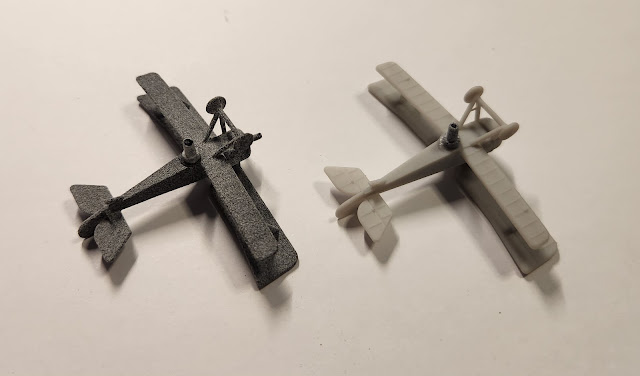
Shapeways on left, Table Top on right. Posts and props as well.

For some months I have had a couple of 1/144 Nieuport N.17s awaiting prep, paint, and decals. One model is a Shapeways with the improved print material, and the other is a Table Top Flights offering. With my recent efforts in adding life to three Ares miniatures, I thought it might be nice to add to my Lafayette Escadrille's stable of available Nieuports.

Preparation
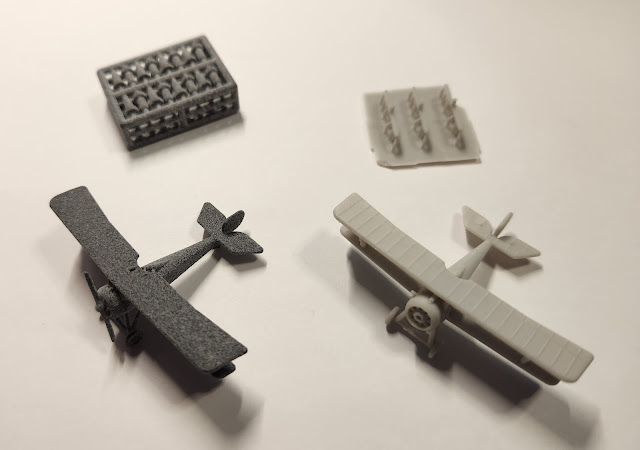
Neither plane came with posts, so luckily I did order posts from Shapeways before they declared bankruptcy. A couple of cuts with the X-ACTO knife to remove the pegs from the sprue, some filing to the edge that gets glued to the plane, and then a little superglue, and the pegs are securely in place.
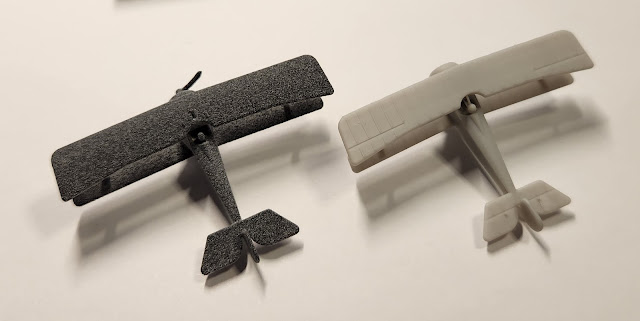
Comparing the two materials - Table Top is smoother and more detailed

Posts added, time for priming

After drying the next step was a coat of primer. Normally I use some AK Interactive gray that I brush on, but last time I used it it had become quite separated, and rigorous shaking yielded undesirable results. Fortunately I had a can of Testers Panzer Gray, which I have used as primer in the past, and I really love the smooth coverage Testors provides.

After priming it was on to painting.

Painting
I already have the "T" and three red bar Nieuports, plus a white band one that I converted from another three bar Ares. Another historical scheme was simply the Seminole Indian head with the national insignia. Okay, that is easy enough. But what about the second one?

My friend Dan (camelbeagle on the Wings of Glory Aerodrome) had a Soubiran version already, using decals from the Valom kit (although I am not certain if the decal's fuselage band color is correct - the decal is black, but the band might actually be red). I also know I cannot pull off letters like "ECP" as that becomes too fiddly and I do not have the ability to print my own decals. One also needs to keep in mind that many of the schemes found searching the world wide web are simply wrong. And the two books I have that include color plates cover the same aircraft I already have or cannot pull off.

And then I remembered - I had bought one of the Nieuports to do a Russian version! And I already have the Russian decals for the scheme I wanted to tackle, and it, too, is a silver doped plane. Sooo, the rest of this post will focus on the Lafayette version, which will simply be a plain plane, with national insignia and Seminole heads!

A close approximation for the silver-doped Ares Nieuport 17 is a mix suggested by Dom from Dom's Decals. Take six parts of Vallejo silver and blend with five parts Vallejo natural steel. I also thin this mix with a little water - metallic paints can be think and I would rather put on a couple of coats of thin paint than a thick one susceptible to clumping. Or, let's make it even simpler - just use Vallejo aluminium (yes, the British spelling). The Model Air range of Vallejo paints are a bit thinner in viscosity, and one does not have to mix paints, and the color is very close to the Ares Nieuports. Plus, we all know that paint widely varied during the war due to weather conditions, and different factories doped fabric differently.
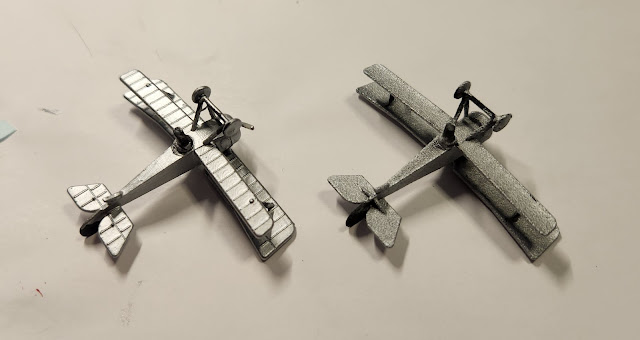

One coat coverage -  the Shapeways version is so shite I am not going to even bother

After the primary color had been applied (and I only needed one coat with a few touchups after), I moved onto the rudder. I used Vallejo white and carmine red, along with Foundry Bavarian cornflower blue (shade 73A).  I was able to use masking tape for the red segment, and I tried lining up a business card to help keep the rest of the lines straight (an idea shared by CrashCraig), but it is still a bit sloppy. And it was the old "Let me fix the white. Damn, went over on the blue too much. Okay, fixed the blue, but got it in the white. Okay, fixed the white, but now I have to correct the red" sort of thing). After doing this several times, I said "feck it" and now it is what it is. From three feet away it looks decent.

While waiting on rudder colors to dry, I added Vallejo flat brown to the outer struts, propeller, pilot, and tail skid. I also painted the machinegun, motor cylinders, and propeller hub Vallejo natural steel. A touch of Vallejo medium sea gray was applied to the tires.


Decals
Now the fun part - the finishing touches that add color to the Lafayette Escadrille Nieuport 17. I used Beacon Publications decals (available from I-94 Enterprises) for the French roundels. Alas, the sizes available do not perfectly align with the Ares planes - for example the top wing roundel on the Ares plane is 7mm, while the closest size Beacon decals are either 8mm or 6mm. I went with the smaller of the two as I did not want the roundel to come across as cartoonish by being too large. Then I applied the Miscellaneous Miniatures Sioux heads to each side of the plane. In both cases I put a spot of Vallejo decal fix on the plane, and after some drying coated the decal with Vallejo decal softener, which allows the decal to conform to the miniature. After drying I then coated the plane with Vallejo gloss varnish to match the other Lafayette Nieuports.


Conclusion
This is the not first Table Top Flight plane I have painted for Wings of Glory (see HERE), and I will say that in every case the material used by Mike at Table Top really does take paint very well, unlike the Shapeways model with it obvious grainy texture. This particular Lafayette Escadrille Nieuport was a rather simple project to take on, and I completed it over the course of three days. The color is a tad off, and perhaps using the mix suggested by Dom might have resulted in a matched aircraft, but overall it works.

Mat - Deep Cut Studio

3.28.2025

Part I - Bringing The Lafayette Escadrille to Life


N.1844 with some bad decal placement. This will be the miniature used for a repaint.

I own three of the Wings of War Lafayette Escadrille Nieuport 17s - two marked with three red stripes on the fuselage side, and one with a "T" on the fuselage. According to Jon Guttman's SPA124 Lafayette Escadrille - American Volunteer Airmen in World War 1 (Osprey, 2004), the three red stripes on the first mentioned Nieuport are "coup marks," but in his Nieuport Flyers of the Lafayette (Albatros, 2006), the three stripes represent Captaine George Thenault's rank. Four different pilots flew N.1844 - Thenault, Lufbery, Hoskier, and Willis, so whether the personal markings represent coup marks of the Native American Indians or the captain's rank, one plane needs to be converted into a different N.17. As one of the models has the three stripes in an awkward position I will use that model for the "repaint."

Colors to be mixed for the repaint

I will be using Dom's Decals suggested mix of six parts Vallejo silver and five parts Vallejo natural steel to paint over the three stripes. Then I will add masking tape to paint a vertical white band around the fuselage to represent Willis Haviland's N.1887, which later became George Hinkle's plane with the addition of an "H" on the fuselage and red trim on the white band.

The rather dark and dull looking Seminole head will be replaced

On all three N.17s the Seminole head looks rather dull, the colors looking rather muted, almost black and white. I will be using decals from Miscellaneous Miniatures to add some color to the planes. While the decals represent the later Sioux motif, I think they will work nicely as Seminole heads and will enhance the plane's colors rather well.

The decals to be used. I have used some on Reduced Aircraft Factory color 103rd Aero SPAD S.VIIs to great effect. See THIS POST

I also need to fixe the rudder flashes on two of the N.17s as the red portion has a bit of decal missing. 

This is a rather easy project, or should be, with really only the masking and painting of the white fuselage band presenting the hardest aspect. I should be able to knock these out over the next couple of days, in time for some Bloody April fighting at the monthly Wright Flight gathering.

Mat - GripMats

11.03.2019

Growing the 1948 Arab-Israeli War Collection

A couple of weeks ago I received my most recent commission work from Kevin Hammond at Miscellaneous Miniatures, some oddball planes needed to complete the remaining scenarios published at Wargames Illustrated, written by Rob Wubbenhorst. Kevin isn't really doing commission work any longer, but as I have used him in the past and was very vocal on various forums about my utter satisfaction with his painting, he graciously offered to keep doing small jobs for me as needed. 

Here we have some Raiden additions for the British, Israelis, and Egyptians in the form of Spitfires, Macchis, a Beaufighter, and a proxy Hawker Sea Fury (really a Tempest with a radial engine). The planes I selected for this period are not 100% spot on, but are pretty close, and used some planes I had picked up from Dom's Decals a few years ago for a really amazing price. Magnets have been added, so now I just need a few convoy vehicles and a ship and I will have all the toys necessary to complete all six scenarios.

As for the scenarios, most are small in terms of player count, so I will be combining a few to be able to host medium-sized games.


4.13.2019

1948 Arab-Israeli War

Nice, a long planned project finally coming to fruition....

I picked up some greatly reduced Raiden aircraft from Dom at Dom's Decals some time ago, for the most part planes that would be correct for use in the '48 Arab-Israeli War.  Using Check Your 6! and a '48 War article (and supplement download) that appeared in Wargames Illustrated (#310) and written by Rob Wubbenhorst, I gathered planes to tackle a few small scenarios from that article. Sending the planes off a few months ago to Kevin at Miscellaneous Miniatures, I received them a few weeks ago, and am really impressed by Kevin's work (again). All I need to do is glue on some magnets and fill out some aircraft sheets and they are ready for Check Your 6! Game Day in June!


2.13.2015

Air War Korea - Part VIII: New Planes!

Several months ago a heck of a sale from Dom's Decals netted me additional Raiden planes to my Korean War collection. I sent six P-51s, four Panthers, and two MiG-15s to the very talented Chris Geisert at I-94 to do his magic, as all my other Korean War planes have been painted and decaled by him and I wanted a consistent quality that having the same person do all the work could provide. Yet again, he knocked it out of the park! Not only does he do great paintwork, but his selection and application of decals really brings the castings to life, which can only enhance the table top.

Again, I'll let the pictures tell the story....

Mustangs were used throughout the war in the ground attack role


My fave Korean War plane...love those four D10s for gunnery in Check Your 6!

The bad guys...er, I mean the misunderstood North Koreans


12.01.2014

Air War Korea - Part VI: Off They Go!

Not too many moons ago I was able to snag some Raiden aircraft that were being sold on The Miniatures Page by Dom from Dom's Decals for a ridiculously low price (thanks, Dom!). In that mix was four Panthers, two MiGs, and six P-51s, along with several other aircraft for World War II (which I have sent to Kevin Hammond at Miscellaneous Miniatures to have painted). Today I put the Korean War planes into a box and mailed them off to Chris Geisert, who works at I-94 and painted a slew of other Korean War aircraft for me a few months ago. Chris does some excellent work as you can see on the pictures on that post, so I am eager to have him finish up my Korean War air project for me. Other than perhaps buying some Yak-9s and Meteors, I will have plenty of planes to cover most of the scenarios in the Check Your 6! Korean War scenario book. This will allow me to host a variety of events with a decent mix of prop and/or jet aircraft. I recently picked up a sky blue gaming mat with 1.5" hexes, so hosting Korean War air games for the upcoming 2015 convention schedule should be easy to do.

4.15.2014

Welcome!

The first post on this new adventure, the Korean War! I will be posting blog entries on an occasional basis that will deal with gaming the war in miniature, along with other tidbits I find interesting. On the miniatures side, the land war will be in 15mm, small unit level, while the air war will be gamed in 1/285th (1/300th) scale. As this is a brand new gaming project, there are a lot of decisions to be made about miniatures and rules, but I do have some ideas in hand.

My Korean War knowledge is slim so I grabbed a few titles from my local Half Price Books and am working my way through them. My father missed Korea, having served in the U.S. Army in the mid-1950s where he was stationed in Germany as part of an armored cavalry regiment. So I do not have any direct connection or reason to have a strong interest in the war, other than it isn't gamed often, the air war saw the first widespread use of jets, and of those jets I really am a fan of the F-80 Shooting Star and F-86 Sabre. I also think that the M26 Pershing is one sweet looking tank. Are those valid or enough reasons for gaming the Korean War?  Damn right they are!

For the land war, there are various companies making Korean War figures, and of course many World War Two ranges can be used. I would almost go with 10mm for this project, but to my knowledge there is only one company (Pithead Miniatures) making 10mm Chinese and none making North Koreans or Allied forces in winter gear, while there are some ranges existing in 15mm. The larger scale of these battles (compared to some of my more modern projects) would lend itself more readily to 10mm, and there are rumors that Pendraken will be making a Korean War range, and that Pithead will be expanding their range, but until those figures are forthcoming 15mm will be the direction I most likely will head. As I am going to work on the air portion of the war first, I do have some time to wait to see if these additional rumored 10mm miniatures are indeed placed into production.

In 15mm there are enough existing figures to put together small unit actions. Quality Castings (part of Old Glory 15s) make Chinese in winter gear, North Koreans in summer uniform, and other forces can be put together from their World War Two range. I have always had a soft spot for the Quality Castings figures as they were some of their first World War Two 15mm figures I ever painted. While some of the poses and details might be a tad dated compared to more recent lines, they still hold up fairly well. I do have an order placed with Eureka (the USA shop) for the North Koreans to see how they look, and will probably order some of the other ranges to see if they blend well together.

For the air war, I am purchasing some 1/285th MiG-15s and F-86 Sabres from a local gamer, along with four air war books and some Dom's Decals. I am not sure who the manufacturer of the planes might be, but I did order some of the Raiden Miniatures via I-94 Enterprises today so I hope I will be able to compare them and determine what manufacturer the local gamer's planes are.

Rules - For the land war these are yet to be determined, but I do have a copy of the Korean War Data Book coming from Olde Dominion GameWorks (ODGW) for their Mein Panzer rules. For air combat some of my gaming friends use Check Your 6! rules from SkirmishCampaigns so I ordered the Korean War supplement today as well. I have only gamed CY6! one time before, years ago, and did not come away with fond memories, but am willing to give it another go before making a final decision on rules.

There will be more to come over the next several days (pictures of minis, etc.) so be certain to check out the blog regularly and leave comments from time to time!