Showing posts with label Nieuport 17. Show all posts

7.04.2025

Delving Into 1/200 - The Planes

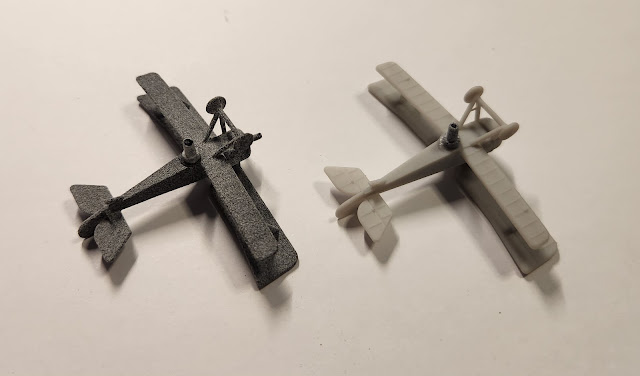
1/200 Scale Table Top Flights Roland D.II
After much time spent trying to find basing solutions and deciding on a scale for the Check Your 6! Great War project, I am going to focus on 1/200 scale - I think. Many planes are available from Table Top Flights, and Mike can create a post on the bottom of the plane that will still function with the Wings of Glory 1/144 scale pegs, meaning that I can use the pegs to represent TALs. With my friend Bob able to print pegs in both clear and translucent blue and creating hex bases in different sizes, I think I am finally onto something. 

With 1/200 now in play, I contacted Sieben Schwaben Spiele Decals to see if they can reduce some of their 1/144 scale Great War decals to 1/200. Yes, they can! Bernhard at SSSD had that request knocked out in a couple of days, and as a result I have placed an order for markings for Jasta 21 (in Albatros D.IIIs) and the 5me Escadrille de Chasse (in Nieuport XXIIIs), along with a sheet of Belgian roundels (you can find these re-scaled decals HERE). This will allow me to do one of the scenarios from Colorful Skies 3...almost. Table Top does not currently offer Nieuport XXIIIs at this time, and while the scenario indicates Nieuport XVIIs, the Belgians actually used the XXIII model, having but a few XVIIs. A quick email to Mike at TTF and he is looking into adding the XXIII, along with some other aircraft not currently on his site.

I also plan to collect Italian and Austro-Hungarian planes for additional scenarios from Colorful Skies 3, but in the meantime there are some scenarios for late war Americans using Nieuport 28s and SPAD XIIIs I can work on as Mike has those planes available. I have sixty-scenarios that feature late war Americans, and while a few of them are huge, many are very manageable in scope, with my target of 4-6 players - more than that and it gets too crowded around the gaming table.

That means that the collection of 50+ planes I have in 1/144 will be thinned out as I move away from Wings of Glory and into Check Your 6! Great War. I will still keep some of my favorites, mostly the ones I have customized or painted from scratch, but the rest will need to be moved along - and selling those will help fund the 1/200 scale project.

4.06.2025

Wright Flight AAR

We had three tables a-rolling for the last Wright Flight gathering, with about four players per table. The other two featured balloon busting, while my table went for Albatros D.IIIs fighting Lafayette Escadrille N.17s during Bloody April. 

Both N.17s had A guns, and with their superior maneuverability I thought they would have a hand up over the Germans, but the two Frommherz D.IIIs did some incredible damage. I was able, early in the game, to make a head on with camelbeagle, which resulted in four points of damage on my end. But I was able get a good reversement onto the tail of camelbeagle's Nieuport, and lit him up a bit. Then I was able to turn into the other N.17 and hit him with a +1 shot, and he drew the boom card (we play the boom card as half damage rounded down, so seven points on the N.17). While both American pilots were able to get off the board without being shot down, they both suffered 10 points of damage each.

Alas, I only snapped a couple of pictures.

We played a second game, swapping out an N.17 for a French Sopwith 1 1/2 Strutter with a random recon mission and random board edge exit point. After successfully taking photos, camelbeagle was heading for home. I lined him up nicely, did some damage, but in return took a pilot wound, which kept me from following up on the Strutter. Dan was able to get off the board while I had taken enough damage to exit as well. The other two players danced around a bit, but results were fairly inconclusive.

20250405_131437.jpg

20250405_133459.jpg

20250405_133503.jpg 

4.03.2025

Adding More Nieuports

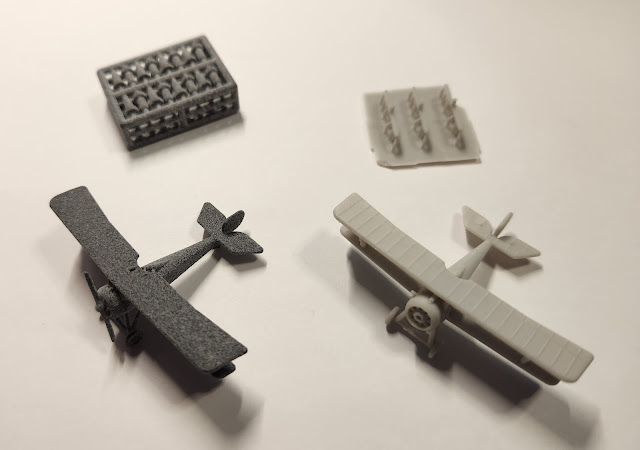
Shapeways on left, Table Top on right. Posts and props as well.

For some months I have had a couple of 1/144 Nieuport N.17s awaiting prep, paint, and decals. One model is a Shapeways with the improved print material, and the other is a Table Top Flights offering. With my recent efforts in adding life to three Ares miniatures, I thought it might be nice to add to my Lafayette Escadrille's stable of available Nieuports.

Preparation
Neither plane came with posts, so luckily I did order posts from Shapeways before they declared bankruptcy. A couple of cuts with the X-ACTO knife to remove the pegs from the sprue, some filing to the edge that gets glued to the plane, and then a little superglue, and the pegs are securely in place.
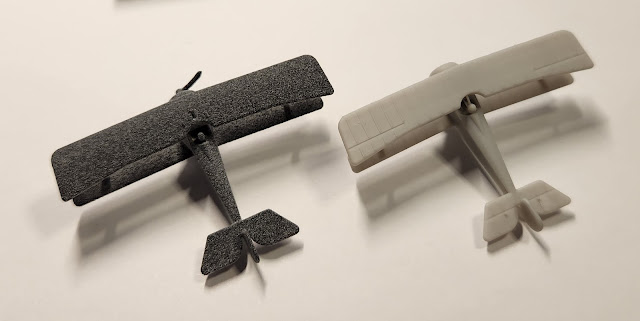
Comparing the two materials - Table Top is smoother and more detailed

Posts added, time for priming

After drying the next step was a coat of primer. Normally I use some AK Interactive gray that I brush on, but last time I used it it had become quite separated, and rigorous shaking yielded undesirable results. Fortunately I had a can of Testers Panzer Gray, which I have used as primer in the past, and I really love the smooth coverage Testors provides.

After priming it was on to painting.

Painting
I already have the "T" and three red bar Nieuports, plus a white band one that I converted from another three bar Ares. Another historical scheme was simply the Seminole Indian head with the national insignia. Okay, that is easy enough. But what about the second one?

My friend Dan (camelbeagle on the Wings of Glory Aerodrome) had a Soubiran version already, using decals from the Valom kit (although I am not certain if the decal's fuselage band color is correct - the decal is black, but the band might actually be red). I also know I cannot pull off letters like "ECP" as that becomes too fiddly and I do not have the ability to print my own decals. One also needs to keep in mind that many of the schemes found searching the world wide web are simply wrong. And the two books I have that include color plates cover the same aircraft I already have or cannot pull off.

And then I remembered - I had bought one of the Nieuports to do a Russian version! And I already have the Russian decals for the scheme I wanted to tackle, and it, too, is a silver doped plane. Sooo, the rest of this post will focus on the Lafayette version, which will simply be a plain plane, with national insignia and Seminole heads!

A close approximation for the silver-doped Ares Nieuport 17 is a mix suggested by Dom from Dom's Decals. Take six parts of Vallejo silver and blend with five parts Vallejo natural steel. I also thin this mix with a little water - metallic paints can be think and I would rather put on a couple of coats of thin paint than a thick one susceptible to clumping. Or, let's make it even simpler - just use Vallejo aluminium (yes, the British spelling). The Model Air range of Vallejo paints are a bit thinner in viscosity, and one does not have to mix paints, and the color is very close to the Ares Nieuports. Plus, we all know that paint widely varied during the war due to weather conditions, and different factories doped fabric differently.
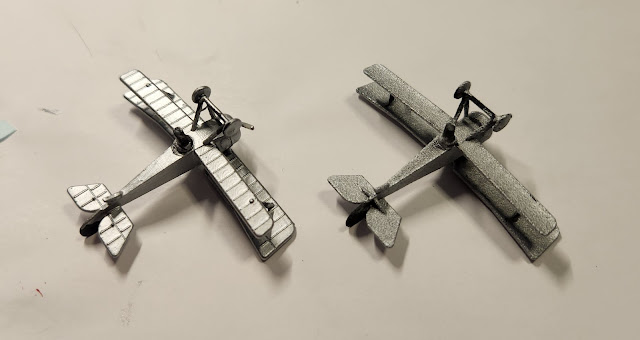

One coat coverage -  the Shapeways version is so shite I am not going to even bother

After the primary color had been applied (and I only needed one coat with a few touchups after), I moved onto the rudder. I used Vallejo white and carmine red, along with Foundry Bavarian cornflower blue (shade 73A).  I was able to use masking tape for the red segment, and I tried lining up a business card to help keep the rest of the lines straight (an idea shared by CrashCraig), but it is still a bit sloppy. And it was the old "Let me fix the white. Damn, went over on the blue too much. Okay, fixed the blue, but got it in the white. Okay, fixed the white, but now I have to correct the red" sort of thing). After doing this several times, I said "feck it" and now it is what it is. From three feet away it looks decent.

While waiting on rudder colors to dry, I added Vallejo flat brown to the outer struts, propeller, pilot, and tail skid. I also painted the machinegun, motor cylinders, and propeller hub Vallejo natural steel. A touch of Vallejo medium sea gray was applied to the tires.


Decals
Now the fun part - the finishing touches that add color to the Lafayette Escadrille Nieuport 17. I used Beacon Publications decals (available from I-94 Enterprises) for the French roundels. Alas, the sizes available do not perfectly align with the Ares planes - for example the top wing roundel on the Ares plane is 7mm, while the closest size Beacon decals are either 8mm or 6mm. I went with the smaller of the two as I did not want the roundel to come across as cartoonish by being too large. Then I applied the Miscellaneous Miniatures Sioux heads to each side of the plane. In both cases I put a spot of Vallejo decal fix on the plane, and after some drying coated the decal with Vallejo decal softener, which allows the decal to conform to the miniature. After drying I then coated the plane with Vallejo gloss varnish to match the other Lafayette Nieuports.


Conclusion
This is the not first Table Top Flight plane I have painted for Wings of Glory (see HERE), and I will say that in every case the material used by Mike at Table Top really does take paint very well, unlike the Shapeways model with it obvious grainy texture. This particular Lafayette Escadrille Nieuport was a rather simple project to take on, and I completed it over the course of three days. The color is a tad off, and perhaps using the mix suggested by Dom might have resulted in a matched aircraft, but overall it works.

Mat - Deep Cut Studio

3.29.2025

Part II - Bringing The Lafayette Escadrille to Life

As mentioned in the previous post, I am working on an easy project on a few Wings of Glory/War Lafayette Escadrille planes to bring them to a bit nicer look.

The first step to modify what will become the Haviland N.17 was to mix paints to match the Wings of War silver-doped color. Using six parts of Vallejo silver and five parts Vallejo natural steel, one can obtain a pretty close approximation. The painted over portion is a bit shinier than the rest of the plane, but this should not be an issue once I give the plane a coat of varnish.

Painted over the three red stripes on the rear fuselage, and have applied a white band

The second step was to use masking tape to paint a white fuselage band around the Nieuport. This was trickier than expected, simply because it was a challenge to hold the plane while trying to line up the tape. But, once I was able to get the two pieces in place, then I applied a coat of Vallejo white. A second coat was added, yielding this okay, but not great result. Good enough for the tabletop, but not for my OCD.

Band in place, three bars painted over

Then it was time to add the Sioux head decals to all the Nieuports. Using a little Vallejo decal fix, and soaking the Miscellaneous Miniatures decals in warm water, I was able to place the decals over the existing dull looking Seminole heads. This addition really brought some life to the Lafayette planes!

Touched up the rudder flashes a bit. Not perfect, but much better than they were initially. I then added coat of gloss varnish which was going to be followed by a coat of matte, but I like the look of the gloss enough to leave it as is. 

Complete!

The new decals are adding a splash of color

Not completely satisfied with the white fuselage band, but from three feet is works

And a video summarizing the project:


Mat - GripMats

3.28.2025

Part I - Bringing The Lafayette Escadrille to Life


N.1844 with some bad decal placement. This will be the miniature used for a repaint.

I own three of the Wings of War Lafayette Escadrille Nieuport 17s - two marked with three red stripes on the fuselage side, and one with a "T" on the fuselage. According to Jon Guttman's SPA124 Lafayette Escadrille - American Volunteer Airmen in World War 1 (Osprey, 2004), the three red stripes on the first mentioned Nieuport are "coup marks," but in his Nieuport Flyers of the Lafayette (Albatros, 2006), the three stripes represent Captaine George Thenault's rank. Four different pilots flew N.1844 - Thenault, Lufbery, Hoskier, and Willis, so whether the personal markings represent coup marks of the Native American Indians or the captain's rank, one plane needs to be converted into a different N.17. As one of the models has the three stripes in an awkward position I will use that model for the "repaint."

Colors to be mixed for the repaint

I will be using Dom's Decals suggested mix of six parts Vallejo silver and five parts Vallejo natural steel to paint over the three stripes. Then I will add masking tape to paint a vertical white band around the fuselage to represent Willis Haviland's N.1887, which later became George Hinkle's plane with the addition of an "H" on the fuselage and red trim on the white band.

The rather dark and dull looking Seminole head will be replaced

On all three N.17s the Seminole head looks rather dull, the colors looking rather muted, almost black and white. I will be using decals from Miscellaneous Miniatures to add some color to the planes. While the decals represent the later Sioux motif, I think they will work nicely as Seminole heads and will enhance the plane's colors rather well.

The decals to be used. I have used some on Reduced Aircraft Factory color 103rd Aero SPAD S.VIIs to great effect. See THIS POST

I also need to fixe the rudder flashes on two of the N.17s as the red portion has a bit of decal missing. 

This is a rather easy project, or should be, with really only the masking and painting of the white fuselage band presenting the hardest aspect. I should be able to knock these out over the next couple of days, in time for some Bloody April fighting at the monthly Wright Flight gathering.

Mat - GripMats

12.15.2024

A Little Wings of Glory Recap

Yesterday was the monthly gaming session of the Wright Flight, and while I was planning on doing Polish-Soviet action using a slew of house rules, the lack of players meant we went with just one table, eventually getting up to eight attendees. 

We did two games of early war action (then why was there an Aviatik D.I on board?), seeing a mix of German aircraft against various early model Nieuports. I pulled out my Escadrille Americaine Lawrence Rumsey repaint for the first game, and in the second game I jumped over to the German side and used my Shapeways Siemens-Schuckert D.I, a copy of the Nieuport 17 but one that performs like the Nieuport 11. In both early war games I took a few hits, gave out a few hits, and jumped off the board before dying in either game.

A cluster of Nieuports, with a new player turning right towards my Rumsey!

Second game's plane of choice!

Nothing to see here (and I survived this passing attack)

Bill, that Halberstadt does make a nice photo.

Matt's nicely painted Shapeways British N.11

Passing planes over the Channel


We played another game with six participants, a later war affair. This time I had a chance to use my little Pfalz Dr.I, and the little beauty performed well. The O Deck is a dream, and I shredded a SE.5a that flew right into my arc. The Allies took a bit of beating...they did shoot down the Baron (well, somebody had to do it) and put some damage on the Fokker D.VII, but with the SE.5a unable to put out its fire and the Camels having taken a crap ton of damage, it would be considered a German victory. We also used my new range sticks from Pro Painted Studios, and they, along with my modified firing ranges, seemed to work well. Next time I'll add in deflection!

The Germans gather

Say hello to my little friend - the SE.5a takes a fire result. I would apologize for my actions, but I wouldn't mean it, and why waste a good apology?

Soon the end of the Baron...no one likes that Prussian anyway


We had a couple of new players, who had a tendency to ignore spatial awareness, or even friendly planes, and plotted turns that caused collisions. Luckily in the late war game my C Damage card was a goose egg for the goose-stepping Pfalz pilot, but Lord, gotta watch those new players!

7.21.2024

The End of a Baer

Paul F. Baer in front of his SPAD S.VII

As you may or may not know, I have a great interest in the Escadrille Americaine/Lafayette Escadrille/103rd Aero. I have a few planes to represent the various stages of this squadron, ranging from two Nieuport N.11 repaints (Rumsey and Chapman), to the Thaw/Lufbery Nieuport N.17, to four SPAD S.VIIs for the 103rd Aero. Also, one of the more compelling American pilots of the war, and one who was the American Ace of Aces for a short spell, was a member of the 103rd, that being Paul Baer from Indiana.

The flight log of the 103rd Aero is an interesting read. While it might not have all the details needed to flesh out scenarios, it does in some cases provide a framework to build a scenario upon. Hence the following scenario idea, based on Baer's last flight of May 22, 1918, in which he was shot down, captured, and kept as a prisoner for the remainder of the war.

The flight took place between 8:45 (when the patrol took off) until 10:45 a. m. (when most of the patrol returned). An hour into the patrol eight enemy fighters were spotted in the Laventie region (the term monoplace being used in the log to denote single-seater) - Laventie being a few miles west of Lille. According to the log, First Lieutenant William Dugan was attacked and in turn he performed a loop and fired but ten rounds until his Vickers jammed. Fellow flight member First Lieutenant Charles Wilcox "piqued" on two of the enemy fighters, which I believe means that he had a height advantage. After firing fifty rounds he was able to shoot down one of the fighters which fell en vrille - spinning out of control. Then First Lieutenant George Turnure piqued on the tail of another German, attacking it, following it for 2,000 meters, when the German appeared to be out of control. Dugan would state that he saw a German being hard pressed by a SPAD, which could have been Turnure's potential victim. It was also noted that the patrol saw a German piquing on a SPAD. Then the report simply states that Lieutenants (Paul) Baer and (Ernest) Giroux did not return. Baer was flying a SPAD S.VII, but Giroux was flying a SPAD SXIII. The 103rd, even when transitioning the the S.XIII would often prefer to fly the S.VII as it was more mechanically reliable.

So, how would one create a scenario from such information? We have five American pilots named to face off against eight Germans. We do not know the types of planes the Germans were equipped with, let alone their Jasta (although Baer had possibly encounters the red nose planes of Jasta 18 previously). Being that is was late May of 1918, there is a chance the fighters were Pfalz D.IIIas, Albatros D.Vas, or even Fokker D.VIIs (these being the most common types in service at the time, there could be other choices as well). Most likely the enemy was not using triplanes as this most likely would have been noted in the log. We do know that Baer was credited with an Albatros on this flight so can assume that at least part of the German flight consisted of Albatros D.Vas.

Dugan was attacked, seemingly even after the Germans had been spotted. Does this mean the Germans had a position advantage over Dugan? Were they tailing the SPADs of the 103rd? How then was Wilcox able to pique on two Germans? Did he maneuver for a height advantage or was he already at a higher altitude?

I would almost suggest starting the various aircraft at random locations. Have each plane roll a die, loser starts in the middle of the playing surface, then next lowest die rolls, using the chart below, to determine their place, then next plane starts based on that position, and so on. Would make a heck of a mess of planes on the table, to be certain!

I would be curious to hear your thoughts on this potential scenario!