Showing posts with label Curtiss P-36/Model 75. Show all posts

6.30.2026

FINNished

After sitting about for several months and lately inspired by my friend Scott who is working on Finns, I completed six Model 75As today. I just needed to do some touchup, add decals, put a little decal set on same, and then hit them with a coat of gloss and a coat of matt varnish. While not perfect (my yellow is so thin that even after five coats there is some bleed and a few other little paint gaffs) they are pretty decent gaming pieces.

Ready to face those sneaky Soviets - looking much darker and shinier in the pic

I went with the early war scheme - as these had been planes the Germans had taken from the French and Norwegians they had been painted in RLM71 (Dunkelgrün) over RLM65 (Hellblau) by the Germans and left that way by the Finns (the more known black and olive green scheme came into use later in the war). I used Vallejo Model Air paints for nearly all the work (the aforementioned RLM71 and RLM65 along with natural metal, chrome yellow, and NATO black), the exception being Foundry Bavarian blue on the canopy. National insignia are decals from Beacon (from I-94) which are nicely done individual decals (although I split one somehow) and finished with numbers from Flight Deck Decals. Oh, the miniatures themselves are crackin' good 3D prints, also from Flight Deck.

The color is better in this snap - and now I see more touchup work needing to be done!

2.02.2026

Operation Torch - The Western Task Force


I have a few Operation Torch posts already on the blog, but I wanted to provide a bit of an update as to where the project stands, including a small scenario book that I will be working on soon, providing a mix of historical and hypothetical encounters that feature the United States Navy's air operations which, as part of the Western Task Force, mostly dominated the skies over Morocco. 

Thus far I have ideas for seven scenarios which include an interesting mix of American and Vichy French aircraft (the following chart includes an eighth scenario from the Check Your 6! rulebook):


I have aircraft painted for two scenarios (French Surprise and Torched), however I might replace some or all of what I have with the exceptional Flight Deck Decals range. I do have the Model 75As already from Flight Deck - I just need to ship them to Miscellaneous Miniatures for painting as doing three tone camo scheme and Vichy stripes might be beyond my skill, or at least patience, level. 

Also, something I want to try to do is offer a mini-campaign aspect for the scenario book. Years ago when I used to game the Command Decision series from GDW, one of the concepts they offered in their Over the Top World War One rules was a "bathtub" campaign - taking units and scaling them down into playable units on the tabletop while also allowing campaign movement using a hex map. I plan on doing something like this for Operation Torch - taking the numbers of available aircraft and scaling that down to 10%. This would yield the following available aircraft for the mini-campaign:


I would have to determine how to use a force pool to generate scenarios, or really I would need a scenario generator and then a way to track the force pool due to shoot downs, damage, etc. Since the campaign was so short (just a few days), any plane that is shot down would not be replaced, and an aircrew survival roll could be made to determine if the pilot is able to return to the force pool. Damaged planes might return after a full day of inaction. There are several factors that need to be accounted for.

12.07.2025

Pearl Redux! After Action Report

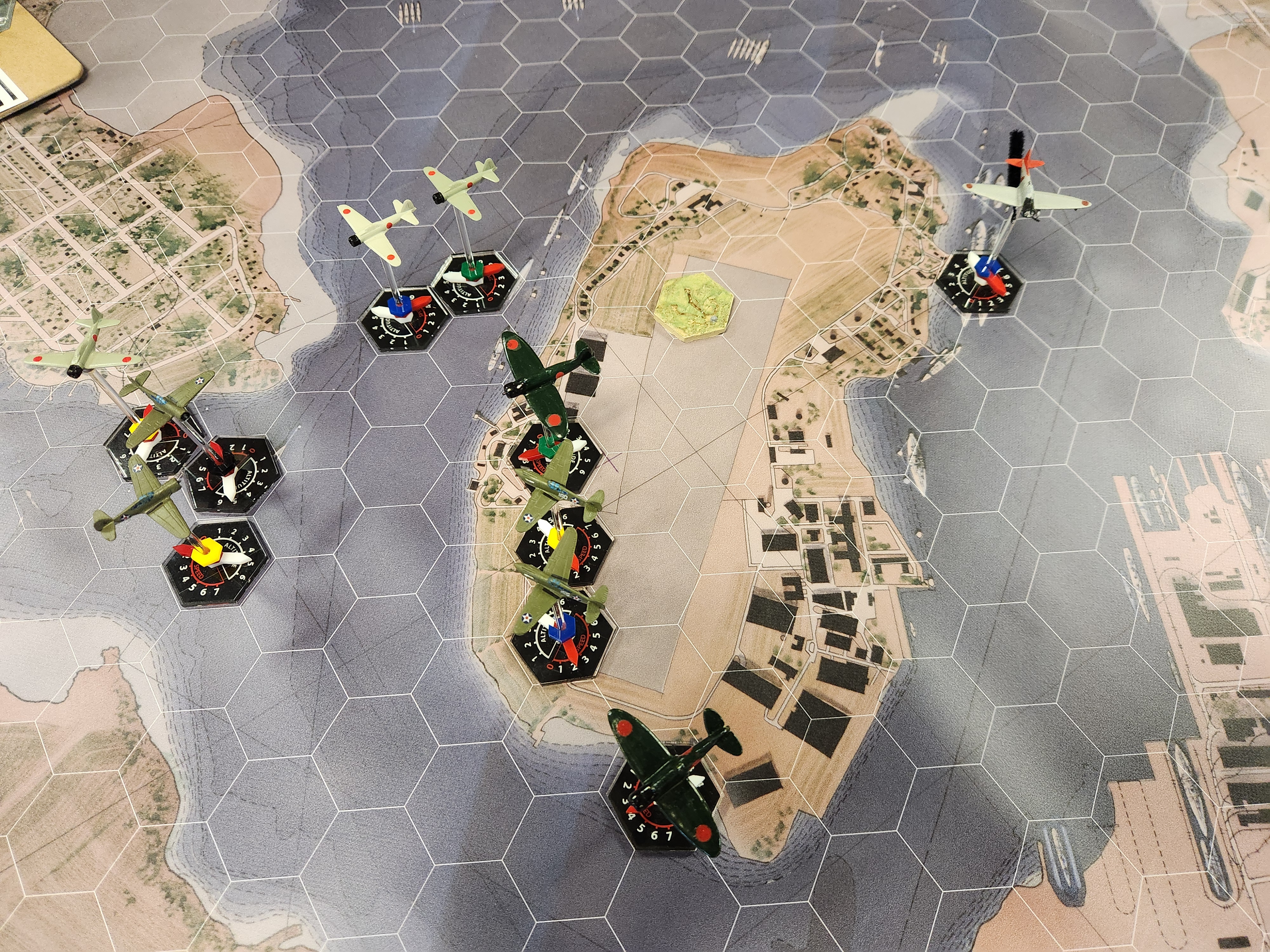
Over Pearl Harbor....

We ran the Second Strike scenario in commemorate the attack on Pearl Harbor. Due to a limitation with the number of players in attendance, we adjusted the scenario to feature Zekes making strafing runs on Ford Island and Hicam Field as we did not have the Vals and Kates needed. Admittedly, my knowledge from the game, played just yesterday, is limited as I actually played in this event and so my point of observation is rather focused, but I will cover what I can remember! Once again I also took few photos.


The Japanese players move in to strafe Ford Island. The AA piece in the distance would be attacked the following turn.

The Japanese players moved into range of Ford Island, dropping altitude in order to strafe the ships and the installations. The dice were HOT for Jay, who not only put down something like five or six successful strafing hits, but he also knocked out the light AA as well. He liked my dice so much he offered to buy them such was his success. With the Japanese already raking up the victory points, the Americans closed in.


Three P-40s and three P-36s move towards the Japanese. I was piloting the two Hawks at the bottom of the picture.

A pair of P-40s started on the board, and the remaining Americans came on during Turn 1 (another scenario change to adjust to the speed to the Zekes). Each turn I dropped my P-36 section one TAL and grabbed the extra hex from the shallow dive. The other two Americans closed into the ranks of the Japanese Zekes, and the furball began.

After pounding Ford Island the Zekes move to engage the oncoming Americans. My Hawks were straining to catch up and the base on one can be seen on the right.

While both sides had mostly skilled pilots, some maneuvers made by the Americans allowed the Japanese to start inflicting damage on the P-40s. It was going badly for the Americans - already in the hole six victory points from the strafing runs, now the Yanks started to fall out of the sky.


As I closed in I dove nearly to the deck to get under the oncoming Zekes. However, I bled off nearly all my speed on an Immelmann and was not in a grand position. That seemed to be the mantra for the American players - we just could not pull off just the right turn codes to really stick it to the Japanese. One, two, then a third American plane fell our of the Hawaiian skies. Finally one Zeke was shot down (if we could hit, then we stood a good chance as the Zeke's robustness is 0). Then my green pilot was face to face with the Japanese veteran. Crap. But the dice were favorable as I shot down the bugger - the return fire proved to be just as deadly as my green Hawk became debris. Regardless, a bit of a morale victory.

Jay had two of his Zekes run out of ammo, but that saving grace really did not matter. The Japanese won this fight overwhelmingly! Four American planes shot down (or was it five) for the loss of a pair of Zekes. The Americans earned ten VPs - the Japanese was something like twenty-two. 

The Japanese only went after Ford Island. In hindsight I probably should have had one group attack Ford while the other attacked Hickam Field. That would have spread out the Japanese Zekes a bit more, and would have aligned with the scenario had we had Vals and Zekes.

Planes - Zekes are Flight Deck Decals (painted by yours truly), P-40s and P-36s are Raiden (painted by Miscellaneous Miniatures).
Mat - custom Pearl Harbor from Deep Cut Studio.

10.10.2025

Rating the Finns - Part II

A war weary Model 75A. The white rings indicate repaired bullet holes.

In a previous post I discussed my thoughts about the low aircrew quality ratings given to the Finns in the Battles Above 4 scenario book. This is not a post to disparage the author of that excellent scenario book in any way, but it is simply my thoughts on how I think the Finns should be rated in terms of Aircrew quality.

I have now gathered several titles on the Finns, in some cases titles in which the author(s) have sourced Soviet records to compare reported losses, and this research has convinced me that the Finns did have some of the highest kill ratios of any nation during World War II, usually flying outdated aircraft, and more often than not outnumbered in the various encounters with the Soviets.

What I first thought was an anomaly, that being the overwhelming kill ratio of Lentolaivue 24, flying Brewster F2As before receiving Messerschmitt Bf 109Gs later in the war, was not the exception, but instead the exceptional example of multiple successful Finnish squadrons. As outlined in another post, Lentolaivue 32, flying the Curtiss Model 75As for three years, also had an impressive kill ratio. But it does not stop there. With Morane-Saulnier 406s and Fiat G.50s other squadrons also inflicted far more casualties on the Soviets than was received in return. So we need to address the question - how were the Finns able to have such success?

"It's the man, not the machine" - and while I mostly agree with this premise, the tools of war can often provide an edge, but not so with the Finns. With aircraft of comparable performance in many cases, with armament on the lighter side, and with machines that were typically no more robust than the enemy, the Finns made up for a lack of quality equipment by the superior quality of their pilots. However, as mentioned in the previous post, the scenarios in Battles Above 4 do not give much distinction in aircrew quality between the Finns and the Soviets. While I usually like the aircrew ratings found in the Battle Above series, and the methodology that the author uses to determine ace and veteran aircrew quality, I believe that same methodology does not "work" during the Continuation War. How do we address this?

I have a few ideas around aircrew ratings for the Finns. The first takes an approach that any Finnish pilot that has five or more kills is an ace (+3). This is different than Battles Above, in which the author uses twenty kills or more before applying ace status. I would make a Finnish pilot with one to four kills a veteran (+2) aircrew, and any other pilot who has zero kills is rated as skilled (+1). Green (+0) aircrews should be extremely rare for the Finns. By taking this approach and applying against the scenarios in Battles Above 4, it will make most Finnish aircrew ratings improve, if one knows what pilots were involved in each scenario. As most of the scenarios only have a pilot or two named, this process would not ideally work, although any green aircrew would be bumped to skilled regardless, at least in my mind.

Another approach is to lower the aircrew ratings for each Soviets by one level, and utilizing the poor (-1) aircrew rating offered in the Korean War scenario book for green pilots, green for skilled, and so on. This potentially would balance the scenarios more towards the Finns, which makes sense to me, as in most of the scenarios they are outnumbered. This might be the easiest adjustment that can be made based on historical performance and the lack of information when it comes to knowing which Finnish pilots were present for each scenario.

A more extreme approach is to use both the aforementioned methods. Based on kill ratios, this actually might result in more historical outcomes but less than ideal balance for the Soviet players. However, in most of the scenarios the Soviet have the numerical advantage. Of course, being a dice game, results can always vary widely game to game so it would take several playthroughs of one scenario to see if any of the methods above provide a more historical outcome.

Here is a look at all three methods, using one scenario from Battles Above 4 in which the Finns are outnumbered. This scenario (65 to 0) had on the Finnish side the following known pilots and the number of confirmed kills each had obtained before this engagement - Aulis Bremer (6.33), Eino Koskinen (7.5), Kalevi Tervo (6.0), Pauli Salminen (3), and Yrjö Pallasvuo (5). 


Using my suggestions for Finnish aircrew quality above, giving ace status to these pilots with  five or more kills, really shows the imbalance, particularly if increasing the Finns and decreasing the Soviets. However, the historical event played out with the Finns claiming eleven kills (there were also present, but not in the scenario, Soviet bombers) to zero losses. The alternate version of this fight (Finland's Hawks, Stalin's Falcons) has the Finns at a greater numerical disadvantage with eighteen Soviet fighters and six Soviet bombers. I cannot imagine playing out this scenario and seeing the Finns so outnumbered and still managing to inflict such losses on the Soviets without making, at the very minimum, a dramatic increase in the Finnish aircrew quality.

It will be interesting to play through the scenarios with some measure of adjustments in place...but first I need to collect and paint planes!

10.08.2025

Lentolaivue 32

Model 75A of Lentolaivue 32 in the later scheme of olive green and black over light blue

For those who have interest in the Continuation War, you probably know of the exploits of Lentolaivue 24 and their amazing successes while using the Brewster Model 239 against the numerically superior Soviets. However, the Finns fielded other squadrons that also delivered impressive kill ratios from mid-1941 until the Finns signed an armistice with the Soviets in mid-1944. One of those squadrons, flying another outmoded American fighter, was Lentolaivue 32. This squadron, which started the war flying Fokker XXIs, supported by a flight of Hawker Hurricanes, transitioned to the Curtiss Model 75A a few weeks into the war. The Sussu (Sweetheart), as the Model 75 was known in Finnish service, served in LLv 32 for three years and chalked up an impressive kill ratio over their Soviet counterparts. I have covered the Curtiss in Finnish service previously (found HERE) so I will not rehash those details. This post focuses on Lentolaivue 32 and its impressive string of victories, even when flying against advance Soviet fighters later in the war.

The squadron received its first victory on June 25, 1941 when Veikko Evinen, flying a Fokker XXI, shot down a pair of Tupolev SB-2. Evinen would obtain four victories in LLv 32, all in 1941. He would later transfer to LLv 34 and obtain ace status before being killed. LLv 32 would obtain 7.5 victories while flying the Fokker. LLv 32's first aces would be Paavo Berg and Kyösti Karhila, both obtaining their fifth kill on September 19, 1941, both victorious over MiG-3s.

A schwarm of Sussus

The following list shows the claims of the squadron, most of the claims verified against Russian archival sources. Note: FR = Fokker XXI, HC = Hurricane, CU = Curtiss, and MT - Messerschmitt.


Let's look at Lentolaivue 32 by the overall numbers. The squadron racked up 206 victories against nineteen losses for a ratio of nearly 11:1. Of the losses, six planes were lost due to anti-aircraft fire, three were lost due to Soviet airstrikes on Finnish airfields, while only ten were lost in combat, yielding a ratio of almost 21:1 when only counting combat losses. Ten LLv 32 pilots were killed, two wounded, and one was made a prisoner of war. Sixty-three of the squadron's pilots had at least a half kill and sixteen pilots made ace status. These numbers are even more impressive when taking into consideration that the squadron was rarely anywhere near full strength.

As seen on the following chart, the squadron was very successful against early war Soviet fighters, but also racked up numerous kills against the superior LaGG-3s and La-5s, again demonstrating the quality edge the Finnish pilots possessed as late as mid-1944.


I will discuss my final thoughts on rating the Finns in a future entry as a follow up to my previous post on Finnish aircrew quality.

1.14.2025

The Commissioned Projects - Part III


One of the most enjoyable Check Your 6! games I have hosted was my hypothetical three way scenario set during Operation Torch (after action report HERE). This scenario pits four French Dewoitine D.520s vs. four American F4Fs vs. four Spanish He 112s, with each faction having one of each aircrew type (ace, veteran, skilled, and green). I also want to do a few historical Torch scenarios, which I am slowly working on creating. To properly cover the Vichy French in the American area of operations one must have Curtiss Model 75s, and so this project is simply adding four Hawks to the collection. The Model 75s will be painted as above, with the Indian head motif of Groupe de Chasse II/5, and adding in the Vichy red and yellow strips, as below.


The planes I have for this project are custom scaled Flight Deck Decals. The quality is top notch as evidenced by the photos that follow.


12.28.2024

When Scales Collide

Most of my miniatures for Check Your 6! are in 1/285th scale, or at least they should be. Recently I grabbed ten Leading Edge Miniatures I.A.R.80/81s from Noble Knight Games. Why? Who knows? Maybe it was because the IKZs I bought previously were so nicely cast that I wanted to collect more Leading Edge planes. I already have I.A.R.80/81s from Table Top Flights (and they are nice), but as I like the obscure and also enjoy a good deal, I snagged the Rumanian planes as well. Call me an addict, but do not expect me to attend any meetings!

All the planes shown are supposed to be 1/285th scale

I wanted to see how the Leading Edge minis scaled against the Table Top versions - I was dismayed to find that the Leading Edge minis are much larger than the Table Top Flights model (a wingspan difference of 5mm - fairly significant on miniatures this small). Okay, so now which company is scaled properly, and which one isn't? A quick check against some other planes shows me that the Table Top Flights, when compared to other aircraft, are scaled comparatively well. So now I have these ten lovely but oversized Rumanian fighters that are...useless.

Another discovery - The Heinkel He 112, both the ones I have from MSD Games (1/300 scale) and the custom order from Flight Deck Decals (1/285th scale) are too small! The wingspan should be slightly larger than the I.A.R.s and about the same as the P-36/Model 75, and significantly smaller than the P-47. The P-36 is made by Flight Deck Decals, and looks to be properly scaled. The P-47, a Raiden product, does have a much larger wingspan. Okay, so now I have tiny Heinkels to deal with. 

UPDATE (6/24/2026) - The Heinkels ARE correct! The data I sourced gave the wingspan of the earlier He 112 and not the B model which had a much smaller (twenty-nine feet) wingspan.

Note to self, and to manufacturers...check the size against other historical aircraft to ensure the mini is in the ballpark.

12.12.2024

The Curtiss Model 75 in Finnish Service

In a previous post I provided the Curtiss P-36/Model 75 in terms of Check Your 6! ratings. This post focuses on the Model 75’s service with the Finnish Air Force.


The Curtiss P-36, known variously as the Hawk, Mohawk, or Model 75, was used very little by its country of origin (the United States), seeing limited action at Pearl Harbor. However, several other nations used the Curtiss, in several different models, with varying degrees of success. France, in an effort to ramp up its military, purchased the Curtiss Model 75, variants A-1 through A-3, which resulted in the Curtiss making up nearly a third of the French fighter force by May 1940. Another country that used the Curtiss with great results was Finland, using captured versions obtained from Germany after France’s capitulation – the Finns utilized the Curtiss well into 1944, and donned the fighter with the name Sussu (Sweetheart). This post will delve a bit into the Curtiss while in Finnish service.

In Check Your 6! the Curtiss handles itself decently well for an early war aircraft. Using the A Maneuver Chart, the Model 75 also offers very good agility (+3) when not moving at maximum speed (4). Speed and firepower are where the Curtiss suffers when compared to aircraft introduced after 1941, but the ability to out turn most opponents along with upgrading the armament with two heavy machineguns (by the end of 1942) keeps the Curtiss relative even into 1944. Factoring in the overall exceptional Finnish aircrew quality, the Curtiss makes for a tough opponent. The A-4 version saw the introduction of the 1200 horsepower Wright Cyclone, but the Finns replaced the Cyclone with the lower powered Twin Wasp as it was deemed more reliable.


Nearly all of the Model 75s served in one squadron during the Continuation War, that being Lentolaivue 32, which completely converted to the Curtiss from the Gloster Gladiator shortly after the start of the war. The squadron typically consisted of three flights (of four to six aircraft each) and a command element. Of the fifty-eight pilots known to fly the Sussu at least sixteen of them became aces, Curtiss pilots claiming 190 kills, with the loss of just fifteen Model 75s, a ratio of nearly 13:1. Versions used by the squadron were the A-1 to A-4, as well as the previously Norwegian-owned A-6, a total of forty-four of all five types having been purchased from Germany. UPDATE (10/9/2025): According to the definitive account (Curtiss Design 75 Hawk P-36 and International Derivatives, written by Dan Hagedorn and Amaru Tincopa), the Finns utilized six Model 75A-1s, nine Model 75A-2s, nine Model 75 A-3s, seven Model 75A-4s, and thirteen Model 75A-6s. The Finns enjoyed flying the Sussu, calling it both robust and maneuverable. One might consider dropping the Agility penalty when moving at maximum speed and potentially increasing the Robustness to R2.

Books

We are blessed with several publications that cover the Finnish Air Force during the Second World War, many of them in English for us non-Finnish speakers. I will not list them all, but instead offer a few useful titles that I own:

Keskinen, Kalevi – Curtiss Hawk 75A – Stenman, 2004. A title that is mostly in Finnish but has English photo captions and an English translation section. Worth grabbing as it is focused mostly on the Model 75 (it does include some information on the P-40M that was captured and used by Lentolaivue 32).

Keskinen, Kalevi and Stenman, Kari – Finnish Aces of World War 2. Osprey Publishing, 1998. Typical Osprey offering that covers the aces that used various fighters in Finnish service.

Keskinen, Kalevi and Stenman, Kari - Finnish Air Force 1939-45. Squadron/Signal Publications, 1998. Numerous black and white pictures with some color profiles.

Persyn, Lionel, Stenman, Kari, and Thomas, Andrew – P-36 Hawk Aces of World War 2. Osprey Publishing, 2009. While there is a heavy focus on the Curtiss in French service, the Finnish use of the Model 75 is also covered in some detail.

Stenman, Kari – Finnish Aces: Their Planes and Units 1939-1945. MMPBooks, 2022. This pricey but large hardcover book (432 pages that weigh in at four pounds) is a deep dive into each Finnish ace, usually with a wartime photo of the pilot, black and white photos showing their various aircraft, and almost always a color profile of one of their aircraft. Included is a list of their victories, both confirmed and claimed but unconfirmed. This hefty book also provides detailed unit histories and several other appendices of information. Well worth the price if you are wanting a deep dive into Finnish fighter aces.

Aircraft Colors

Aircraft colors are often the subject of debate and confusion. However, the colors used on the Finnish Curtiss have been documented extremely well. I was able to find on the interwebs a document compiled by A. S. Marshall that provides Federal Standard 595b, RGB, and CMYK equivalents for not only the exterior but also for identification markings. The information for the Federal Standard colors came from Suomen ilmavoimien maalaukset ja merkinnät (Finnish Air Force camouflage and markings), written by Kari Keskinen, Kari Stenman, and Klaus Niska, published in 1996 by Apali Oy.

Early Model 75s in Finnish service were painted olive green on the upper surfaces and fuselage sides, with light blue under surfaces (RLM 65 should work as a good substitute). Later Finnish Model 75s were painted black and olive green on the upper surfaces, tail, and fuselage sides, with the under surfaces painted in light blue (some illustrations show light grey). As the black was faded in most cases, I suggest mixing light gray at a ratio four parts black to one part light gray. As with German-allied forces on the Eastern Front, the use of yellow on the cowling and under surface wingtips, along with a yellow fuselage band, were added to the Model 75s. Each flight had a distinctive color used for the aircraft number that appeared on the tail (yellow, white, or insignia blue with white outline). The aircraft number was the last digit of the plane’s serial number, a combination of a two-letter aircraft manufacturer code (CU for the Curtiss) and a three-digit number (example: CU-581 had a 1 on its tail). The serial number appeared in black on both sides of the fuselage. The hakaristi national insignia appeared in six positions (top and bottom of the wings and on the fuselage sides). Propeller hubs were usually painted black. There seems to have been no designated squadron insignia used for Lentolaivue 32.

AK Interactive makes a set of four acrylic paints for the Finnish Air Force. The colors included are black, olive green, light blue, and light grey. Arcus Hobby Colors also has a line of paints, available in enamel or acrylic, tailored for the Finns including a set for the Continuation War that has white, black, olive green, light blue, yellow, and grey. Lifecolor also makes a Finnish aircraft set, the acrylic colors being olive green, light grey, two shades of light blue, yellow, and black. 

Decals

Blue Sky Decals, Combat Miniatures, GHQ, Heroics & Ros, Hostile Aircraft, and I-94 Enterprises all make Finnish hakaristi in 1/285 or 1/300 scale. I am sure there are others, but these were the ones most prominent when searching online. Before someone makes a comment about the illustration of the hakaristi keep in mind that it was a symbol of luck prior to its modern day connotations.

Scenarios

In the Battles Above 4 scenario book (which features Eastern Front scenarios and available from I-94 Enterprises) there are three scenarios that include Model 75s (Claims For Everyone, Attack is the Best Defense, and 65 to 0). On the Check Your 6! discussion group there is also a scenario titled Finland’s Hawks, Stalin’s Falcon’s. The maximum number of Finnish Model 75s one would need to do all four scenarios is a very reasonable seven miniatures.

Where to Buy

There are a few companies making the Curtiss Model 75 in either 1/285th or 1/300th scale. As I use the former, I will list only those companies making 1/285th Model 75s that I have dealt with and highly recommend.

Flight Deck Decals – If I was choosing just one manufacturer, I would have to go with Flight Deck Decals. They offer the Curtiss in 1/300 but will do large custom orders in 1/285. These are printed planes, but the quality of the print and the material used is so good as to be amazing. You can find the Curtiss listed in two places – Other Nations WWII and USA WWII planes (both of these are found under the 3D Miniatures tab). In both cases look for Curtiss P-36-H75 Hawk. The price per plane at the time of this post was a trifling $2.10.

Raiden Miniatures – Code USA29 P-36 Mohawk can be found under the United States listing. At the time of this post, cost per plane was $3.00. My P-36s for Pearl Harbor are Raiden Miniatures. They are cleanly cast (being a newer addition to the Raiden line). Service from I-94 is exceptional, and they have online ordering.

Table Top Flights – A company with equally exceptional service, these are resin printed miniatures. Under the United States listing, look for Curtiss P-36/Hawk 75 (product code A-08-009-285) and be certain to click on the 1/285 box (they also make the Curtiss in 1/200 and 1/144). Cost is $3.50. The detail is excellent if subtle and the planes are cleanly printed. Easy to use online ordering makes working with Mike at TTF a breeze.

12.08.2024

Pearl II!

Yesterday I hosted a Pearl Harbor Check Your 6! event featuring the Second Strike scenario (found under the Downloads page above). Being that it happened to be December 7th, I thought it would be an ideal scenario to run.

We wound up with eight players for what is really about a six player game, but was able to get everyone into the game. Thanks to my long time friend Matt for providing the Japanese forces! Also, it was the birthday of another long time friend, so I hope you enjoyed your day, Scott!

Setup for the game see the Japanese approaching from the northeast, while the Americans heads in from the northwest. Six Zeros are escorting three Kates and three Vals, the Kates heading to Hickam Field and the dive bombers targeting Ford Island and Battleship Row. Unlike the first time I hosted this game, the Japanese had four successful bombing runs (at four victory points each) and a number of successful strafing attacks by the Zeros. The American anti-aircraft, particularly the medium guns, placed some hits on the Vals, and those four d10 should have shredded the fragile dive bombers, but passing robustness rolls seemed to be the mantra on the part of the Japanese players. One Japanese plane did run out of ammunition fairly early in the game, but it looked like it was going to be quite the overwhelming win for the Emperor's forces.

The American fighters, consisting of three P-40s and three P-36s, finally made their way into the fight. However, American gunners on the ground did not seem to care about national insignia and fired at the Americans nearly as frequently as they were at the Japanese planes. The Japanese, after having pounded their targets, were trying to move towards their friendly edge, but the American fighters started wreaking havoc, and Japanese planes started falling from the sky and several others were damaged. One Japanese plane took a blackout lucky hit (which I had never seen before in our games) but was able to recover the following turn. 

The Americans turned the tide, and by the end of the sixteenth turn, edged out a victory with a score of 28 to 24. It was a hard fought affair! I think one thing the Japanese might have done was to escort the bombers a bi more closely - the Vals pretty much fought on their own hook as the Zeros focused on Hickam Field and the area between Ford Island and Hickam.


The initial American force - a pair of P-40Bs

A gaggle of Zeros!

Kates and Vals making their way

A pair of pretty birds - the P-36/Hawk 75 has become one of my favorite aircraft

On the right, three Zeros strafe Hickam while the Kates line up for their bombing run. On the left the Vals are pounding Ford Island and Battleship Row

The mixed section

The Vals are now being targeted by a pair of P-40s

The strafing Zeros turn towards the northwest while the Kates have hit Hickam Field

Did I mention my affinity for the P-36/Hawk 75?

The Americans have scattered the Vals, shooting one down while damaging the remaining pair

One Val left, while the Zeros seem to flit about

Endgame

I used the custom mat I had made by Deep Cut Studio, the American planes are all Raiden, wonderfully painted by Kevin Hammond at Miscellaneous Miniatures. The Japanese planes I believe are a variety of manufacturers - painted nicely by Matt.

11.16.2024

Pearl!

Last weekend I hosted a Check Your 6! event at the local shop. Using the Pearl Harbor Second Strike scenario, slightly modified to accommodate the number of players, we were able to recreate the scenario using the custom Pearl Harbor mat from Deep Cut Studio. We cut the Japanese by three Zeros, reduce the American anti-aircraft by half, and remove one P-40 and one P-36, trying to balance the game for five players.

The Japanese looked overly powerful from the start as the American setup seemed too far to have much impact. Luckily the Japanese missed on every bombing attempt, but were successful with several strafes, racking up points along the way. The American anti-aircraft caused a few hits, and one green American P-36 was very successful in not only fighting off the Zeros, but also causing damage in turn. The Americans closed the points gap, but by the end the Japanese squeaked out a victory.

Hoping to run this again with a full complement of players.


Planes - Americans are Raiden

10.27.2024

The Curtiss Hawk 75 for Check Your 6!

One of my favorite aircraft from the Second World War (and I do have several) is the Curtiss Hawk 75 (also known as the P-36). When in flight the sleek lines of this maneuverable yet rugged aircraft are apparent. Some confusion arises when trying to differentiate between the various armaments carried on each model, as well as how each model is designated. 

The P-36 was nearly obsolete by the time the Second World War started, but it was used by several nations early in the war, and by the Finns with great success well into 1944. Developed in 1934 in response to the U. S. Army's request for a low wing all metal-fighter with retractable wheels, the Hawk's main competitor was the Seversky P-35. The Seversky was eventually selected, even though it was slower and more costly to manufacture. However, Curtiss did receive a contract to build three prototypes. An improved Curtiss, using a Pratt & Whitney 900hp Twin Wasp engine, won the 1937 competition, resulting in an order for 210 P-36A models. While the P-35 was also put into production, only 196 models of the Seversky were built. By comparison, over one thousand Hawks were produced. Eventual users were Argentina, Britain, Brazil, China, Finland, India, the Netherlands, Norway, Peru, Portugal, Thailand, South Africa, and the United States.

The French received 316 Curtiss fighters where they were designated the Curtiss H75-C1. While the Curtiss made up 12.6% of the French single-seat fighter component, the H75 accounted nearly a third of the French kills during the 1940 campaign. The Vichy government would use the Curtiss in North Africa, where the H75 faced off against American Wildcats during Operation Torch.

The Finns, who nicknamed the Hawk "Sussu," received a wide variety of Hawk 75A models from captured French and Norwegian stocks. In 1942 they upgraded the armament to include one or two heavy machineguns, retaining the light machineguns in combination to provide a total of six weapons per plane. The Finns repeatedly mentioned the ruggedness of the Hawk, so a robustness rating of R1, while aligned with contemporary airframes, might be on the low side. The Sussu was used successfully during the Continuation War through mid-1944.

What follows is a chart listing the various models of the Hawk. I am thinking that the increased horsepower should result in better performance, so perhaps one might drop the (-) for agility on the models with the 1200 hp engine.

10.20.2024

Commission Work in Hand!

Kevin at Miscellaneous Miniatures reached out to me recently let me know that he was once again doing commission work, and of course I just happened to have planes sitting about waiting to be painted! I sent him two small Check Your 6! projects, those being Pearl Harbor and Burma. The Pearl Harbor scenario you can find on the Downloads page above, and the Burma planes will allow me to do a few scenarios from the Battles Above Pacific scenario book. Here are some pictures of Kevin's work (and these pictures do not do justice...the planes are so much cleaner looking in person).

Flying Tiger Project:


Pearl Harbor Project (my buddy Matt has the Japanese covered):


And the details on the undersides of two of the planes:


These two projects are now complete, short of adding magnets.

Kevin offers high quality paintjobs at affordable prices. The planes for these two projects were $5.00 each.